Monday, May 6, 2013

Sunday in Patsy's footsteps


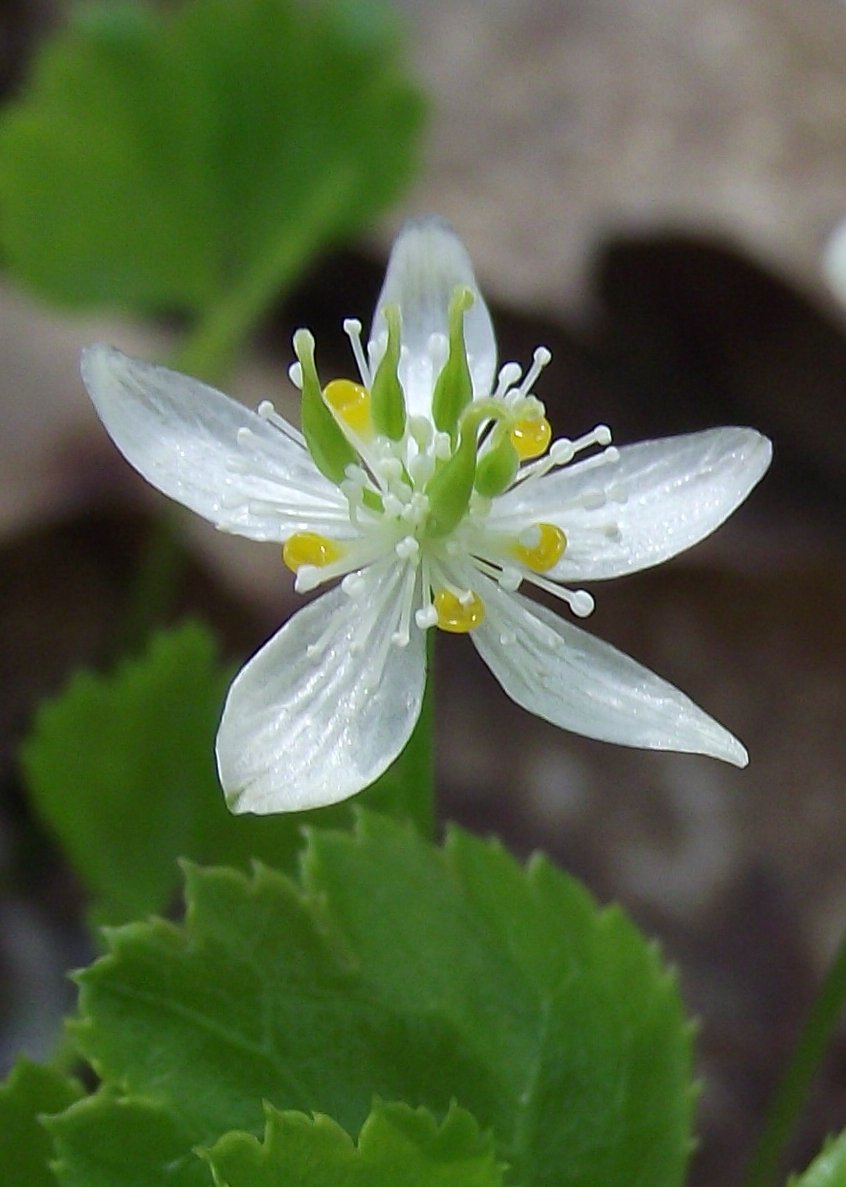
 It was a beautiful morning as you can see in the upper field of what is now Black Birch Vineyard. At the back of this field, in the woods where it became quite boggy I found two flowers... The first flower photo is Gold Thread,  and is on Patsy's list from 1942. The second flower photo is of Dwarf Ginseng and this flower is not on her list.
Gold Thread was found in a rather boggy area near what I believe to be an animals den. This flower is interesting to me because, what you think are white petals are really sepals, and if you click on the photo you will see what looks like short yellow cup shaped lollipops that are nectar holding petals. The stamen are white and longer than the petals. The styles are bright green. This plant is called Gold Thread because if you dig up the plant you will discover a network of  gold colored fine roots coming from the rhizome of this plant. Early in this countries history, Gold Thread was used to make medicine by the American Indians and the Colonists, and that more medicine made from Gold Thread was sold in Boston than any other medicine.
The second flower is Dwarf Ginseng and is not the Ginseng that is used for medicinal reasons. Unlike its relative that has been over harvested and now considered rare in 31 states, this one is not in danger and if you dig up the tuber ...it can be eaten raw or boiled.

In my last entry, Sessile Leaved Bellwort, I wrote that Patsy did not find this flower on her farm in 1942 but actually she did. I discovered it this morning on her list.

Sunday, May 5, 2013

Sessile Bellwort / Wild Oats


The Generic name is Uvalaria Sessilfolia which is said to be derived from the word Uvula, which is that small fleshy piece that hangs down at the back of our throats. If you look at the photos you will see where they were going when they named this flower. The Latin is Sessilis folium, which refers to the way the leaves are attached to the plant with no stem, thus the name Sessile Bellwort. The writer of Doctrine of Signatures ( "a means in which Divine intent was communicated to mankind" ) saw the resemblance to the way the Uvula hangs down and the way this flower hangs down and it was then assumed that this plant could be used to cure and sooth sore throats and/or treatment for the mouth cavity in general. Even our American Indians back in the 1700's were using this plant for the same purpose.
I didn't see this flower on Pat's list ... but some of her flowers have names that were used then and aren't used so much now so I will let you know if I find out differently.
Posted by Picasa

Wednesday, May 1, 2013

Field Pansy


Often times I take the photo as close up to the face of the flower as I can. This is what I (and probably many others) call a "bees eye view". Today's Field Pansy is not much bigger than my finger nail. Click on the photo and you will see what the bee is looking for... the dark lines leading up to where the nectar is. The lines are to bees, what the lights lining the airport runways are to airplanes. It shows them in what direction to come in for a landing. The hairs around the opening lead the insect's proboscis down into the spur where the nectar is waiting. As I have written before this tiny plant has such big plans... Though you can't tell by looking at it, it has the potential to produce up to as many as two thousand five hundred seeds. And, if I remember correctly it has the strength to cast off those seeds as far away as thirty feet. I did not see this plant on Pat's list.... but I bet that in the year 1942 Pat and her siblings were gathering some of the flowers we have mentioned to fill May Baskets. Happy May Day everyone. Give someone a basket of flowers and remember each basket comes with a kiss.
Posted by Picasa

Monday, April 29, 2013

Marsh Marigold


This flower is not a marigold at all. Neltje Blanchan writes that it is during the Middle Ages when it was probably named Marigold. Its early Spring arrival may be the reason it is suppose to be one of the blossoms devoted to the Virgin Mary during church festivals. It is the flower that Shakespeare is refering to in "Cymbleline", when the musicians sing "And winking Mary-buds begin to ope their golden eye" . Neltje goes on to say that in April, in Avon, the watery meadows twinkle with Marsh Marigolds.

Pat found this flower in 1942 and called it Cowslip, another of its names.
Posted by Picasa

Tuesday, April 23, 2013

Bloodroot

Isn't this flower just beautiful? The Bloodroot flower can appear shy, hiding in one of  its leaves that wrap around like  a cape. It is not really shy, it is just waiting for the right temperature or even the warmth of the sunlight to reach it, then it will reveal itself to all of us who admire its beauty.
I think that one of the interesting characteristics of this plant is its ability to self-pollinate. The flowers usually last about three days. At the end of the three days, if the insects have not passed the pollen from the stamen to the stigma, the flower takes matters into its own hands. The stamen at this time move inward toward the stigma in hope that some of their pollen will reach the stigma and thus starting the process of making seeds for the next season. We walk in the woods admiring these beauties ... but thinking them quite without goals and intelligence, not realizing that as we pass they maybe moving silently to accomplish one of its most important tasks.... pollination.
Posted by Picasa
Pat did find this flower on the farm in 1942.

Monday, April 22, 2013

Trout-Lily


This week has brought forth some lovely Spring beauties. Elinor, who was rarely if ever called Elinor, went by the name Pat, a nick-name her father gave her, found in the year 1942 about fifteen wild flowers by the end of this week in April. I have found about the same, though they are not all the same as the ones mentioned on Pat's list. I will list both lists so far at the end of this blog entry.
Trout-Lily or Adder's Tongue is one of the flowers on both our lists. This years flowers are quite small compared to some of the past years I have discovered them. I think it may be the dryness of this year. If you see a Trout-Lily flower and find it surrounded by many Trout-Lily leaves but not many flowers, what you are seeing is the younger sisters of the flowering plant. The first year one leaf is put forth and it gathers enough energy to store for next year in its underground bulb. The second year can produce a second leaf and these two leaves work together to produce enough food to be stored for the third year. The third or fourth year produces a flower. If you get a chance, click on the flower image and you will notice the reddish anthers. Look closely and you will see that a few of the anthers are shriveled and covered with pollen. Tomorrow the other anthers will shrivel revealing their pollen. This, they believed is so that a greedy bee can not make off with all the pollen. The second day gives this flower a better chance in the world of survival of the fittest.
1942
Bluets
Adder's Tongue (Trout Lily)
Mayflowers
White violet
Dandelion
Bloodroot
Five Finger
Purple Violet
Spring Beauties
Wind Flower
White Hepatica
Yellow Violet
Cow Slip
Sessile-leaved Bellwort
Wild Oats
2013
Birds Eye Speedwell
Chickweed
Colsfoot
Bloodroot
Trout Lily (Adder's Tongue)
Ground Ivy (Jill-O-the-Ground)
Wind Flower
Lesser Celandine
Marsh Marigold
Bluet
Wild Oats
Dandilion
Kidneyleaf Buttercup

Posted by Picasa

Friday, April 19, 2013

Coltsfoot


Elinor, the 14 year old girl of 1942 grew up on a farm that has one of the most spectacular views in New England. The name of that farm today is Black Birch Vineyard... and even though the name has changed, and I may not find all the flowers that Elinor did, one thing remains the same.... the beauty of this parcel of land. I ventured down to the North branch of the Manhan River and found this Coltsfoot flower growing on its banks. One of the interesting characteristics of the Coltsfoot flower is that it comes up before its leaves. One of the names given to this flowering plant, and there are many, is filius-ante-patrem, which is Latin and means, son before father. What you are seeing are two different kinds of flowers on the same flower head. Ray flowers which resemble sun rays, and disk flowers which are in the center. (If you click on the flower you can see this more clearly) Even though it looks like a Dandilion it is really quite special... it is what is called monotypic, which means it is the only species within its genus.

Elinor did not mention Coltsfoot on her list.

This years blog starts on April 15th 2013, Spring! A new Beginning, is the title. If you would like to know the back ground story to this years blog, please go back and read about how Elinor became part of this blog.
Posted by Picasa